Quick verdict


Both are fully open-source, hardware-certified cold wallets — the two names most often mentioned when transparency matters most. OneKey leans on multi-chip redundancy and a modern touchscreen; Trezor leans on a decade of public track record and a lower entry price. We compare the security model, the features and the price.


OneKey is a touchscreen hardware wallet with fully open-source firmware and companion app, independently verifiable unlike closed-source competitors. The Pro model uses four separate EAL6+ certified secure elements rather than just one, and adds a SignGuard layer that flags risky transactions before you approve them. It has been SlowMist-audited, though one older, discontinued model was the subject of a publicly documented hack.
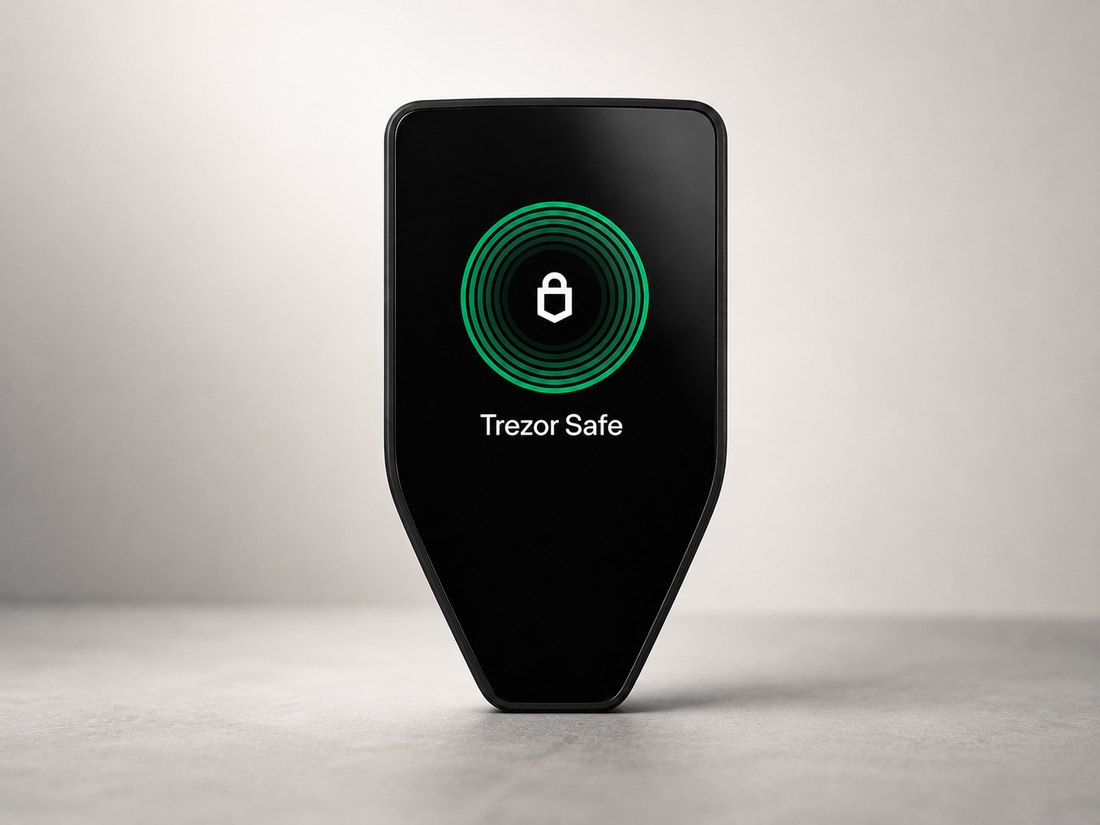
Trezor is the original hardware wallet, launched in 2014, with entirely open-source firmware and companion app that anyone can independently review. The current Safe 3, Safe 5 and Safe 7 models all ship with a certified EAL6+ Secure Element — hardware protection its earliest models lacked — starting at $59 for the Safe 3. It supports Shamir/Multi-share Backup to split a recovery seed across multiple physical shares. An August 2026 breach at a fulfilment partner is a recent negative worth knowing about, though Trezor says no wallets or devices were compromised.
| OneKey | Trezor | |
|---|---|---|
| Type | Touchscreen / card | Button / touchscreen (Safe 3/5/7) |
| Screen | 3.5" touch (Pro) | Mono 0.96" to 2.5" touch |
| Connectivity | USB-C + BT + QR | USB-C (+ Bluetooth, Qi2 on Safe 7) |
| Chip | 4× EAL6+ (Pro) | EAL6+ |
| Open source | Yes | Yes |
| From | $79 | $59 |
Figures compiled from official specifications and manufacturer pages (2026) — always verify current specs and pricing on each manufacturer's website before buying.
Yes — both companies publish their firmware and companion apps as open-source, independently reviewable on GitHub, which sets them apart from closed-source competitors like Tangem or SafePal.
Trezor's entry-level Safe 3 starts at $59, versus $79 for OneKey's Classic. OneKey's Pro model, with its touchscreen and four secure elements, rises to $278.
OneKey's Pro model uses four separate EAL6+ certified secure elements rather than one, which is a meaningful redundancy advantage. Trezor's current Safe 3, Safe 5 and Safe 7 models each ship with a single certified EAL6+ Secure Element — a newer addition that closed a gap its earliest models had.
Trezor, by a wide margin — it launched in 2014 and effectively created the hardware-wallet category, giving it over a decade of public, adversarial security research. OneKey is a newer entrant with a shorter public history.
A fulfilment partner Trezor uses was breached in August 2026. Trezor has stated that no wallets or devices themselves were compromised as a result, but it's a recent incident worth weighing against Trezor's otherwise long track record.
Both links below are our own referral links — buying through them costs you nothing extra and helps support this independent comparison.
15FYN3
If you buy through our links we may receive a commission — at no extra cost to you. Our assessments, including all criticism, are editorially independent of commissions; referral disclosure: this site is partly financed through referral/affiliate links, where available.
Responsible for this website:
Sharif Ahmad
Dubai WTC, One Central Building C3/L3, Sheikh Zayed Road, P.O.Box 9573, UAE
E-mail: info@coldcompare.com
ColdCompare is an independent publication and is not affiliated with OneKey or Trezor. All brand and product names are the property of their respective owners and are used for identification only.
1. Controller: Sharif Ahmad (contact details are provided in the legal notice above).
2. Server logs: the hosting provider necessarily receives technical request data such as IP address, time of access and browser information when the site is delivered.
3. Preferences and analytics: the site stores your language and cookie choice locally. Google Analytics 4 is optional and is loaded only after you choose “Allow all”. If you choose “Necessary only”, GA4 is not loaded.
4. External services and links: no external font provider is loaded. If analytics consent is granted, the browser connects to Google for GA4. Outbound manufacturer and affiliate links lead to third-party sites whose own privacy and cookie policies then apply.
5. Your rights: depending on applicable law, you may have rights including access, rectification, erasure, restriction, objection, portability and the right to complain to a supervisory authority.